Governments long enchantment with, and fear of, the clamorous, pro-Israel Jewish Establishment has ended. This is the symbolic meaning of Foreign Secretary Ed Miliband’s announcing sanctions against the settlements of the West Bank. The substance of the sanctions proposed may not amount to much so far as agricultural products are I concerned, but there is the prospect that they could be built upon.
Over and above produce, services such as construction, financing, infrastructure are to be sanctioned. The degree to which any of this will bite, and the vigour with which the policy is implemented, we shall see in the coming weeks and months. It is axiomatic that Israel, no doubt with the USA, will work to sabotage such measures that are actually taken.
A bubble pricked
In announcing the sanctions, Miliband pricked the bubble of the Jewish Establishment’s self-regard. There is nothing within his statement that gives comfort to it, neither in terms of its content, nor its timing. True, Miliband emphasised that none of the measures were designed to hurt or affect Israel proper within the fabled, green line. But that is no more than repeating long-established and known Government policy.
Indeed, that green-line Israel is not the target of sanctions, represents a fundamental flaw in the premise upon which the proposed sanctions are based, as is the dogged commitment to a two state ‘solution’, which offers no solution at all. However, neither the sanctions as such, nor the so-called two state solution, are the focus of this article.
The sanctions announcement bear all the hallmarks of meticulous preparation. On the 10 August, a little over a month before Miliband announced the sanctions, the Board of Deputies and the Jewish Leadership Council met the Foreign Secretary around a very impressive table, presumably at the Foreign Office.
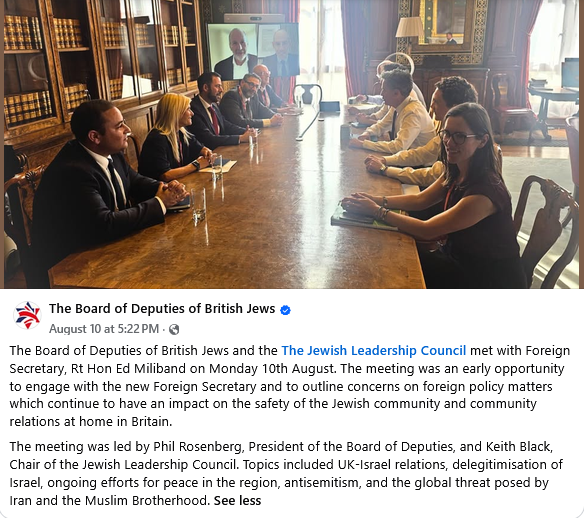
I briefly discussed[1] this meeting, and that table, in an earlier article. I couldn’t help thinking that the Jewish Establishment representatives were being set up, and the purpose of the meeting was essentially performative: to show government was listening and giving Jewish community ‘representatives’ due accord. Not in relation to the yet to be announced September measures, but in general. Essentially, an exercise in ego-massaging.
Played
The Jewish Establishment, fronted by the Board of Deputies and the Jewish Leadership Council – have been played. Played by the Foreign Secretary and Prime Minister Burnham. The message the sanctions’ statement sends to the Jewish Establishment and its allies, not least the so-called Chief Rabbi, is that their pretty-well free-ranging writ to influence government policy on Palestine/Israel is, from now, curtailed.
One demonstration of Jewish Establishment‘s more limited influence is demonstrated in Miliband’s clear declaration that the ‘British Government agrees that there is ethnic cleansing of Palestinians in areas of the West Bank – perpetrated by settler terrorists’ allied with the announcement that ‘the official view of the British Government is that [Israel’s] occupation is unlawful’. These two positions, so clearly stated, and so clearly uncongenial to the Jewish Establishment, represent both a practical and psychological governmental reframing of the UK’s response to Palestine/Israel issues as it affects domestic politics. Government has assessed that the time has come to take on the Jewish Establishment’s see no evil, hear no evil stance in respect of Israel.
Thus, we have witnessed the unusual, probably unprecedented, sight of Chief Rabbi Mirvis being publicly contradicted by the Foreign Secretary. Mirvis was wrong, said Foreign Secretary Miliband, to assess that British Jews are at greater risk of antisemitism as a consequence of the UK sanctions[2].
The two statements highlighted above, along with the riposte to Rabbi Mirvis, presages a change in the dynamics of the relationship between Government and the various incarnations of the uncritical pro-Israel Jewish lobby whose anguished bleatings are now likely to have less purchase with government. This again was indicated by Miliband referring to, though not naming, Edgware United synagogue which held a ‘Great Israeli Real Estate Event’ marketing land and property located in the illegal settlements of the West Bank.
United Synagogue is a key UK Jewish institution, with Mirvis as its spiritual guide (make of that what you will). Notwithstanding United Synagogues central role in the architecture of UK Jewish communal/religious life, Miliband in his Common’s statement said: Earlier this year, shamefully, just a few miles from here, we saw an expo advertising illegal settlement land. We must and we will ensure this never happens again, so we will ban the advertising in the UK of illegal settlements. A bullet has been bitten. A space opened up
In biting that bullet, Burnham and Miliband must have factored in their sense that the general public look askance at the pro-Israel lobby, so that their public relations flank was not exposed. From this perspective, Government deciding to make the announcement just before the Jewish High Holidays of Rosh Hashanna and Yom Kippur must have been consciously chosen – a deliberative act signalling limitations on the reach of the Jewish Establishment’s influence in foreign affairs.
Unusually, mainstream media, around the sanctions issue, has reported Jewish, Israel-critical opinion. Not enough, and late in the day, but a change nonetheless. To that extent, the pro-Israel Jewish Establishment must be wondering what has hit them. Their capacity to induce fear in the UK political and media establishment has, for the moment at least, been diluted, though not fully vanquished.
Into the newly expanded space there needs to flow Jewish Israel-critical opinion, secular and religious[3], in support of the Government’s proposed sanctions whilst at the same time vigorously highlighting their limitations and demanding wider and more stringent measures.
The very fact that Jewish, Israel-critical voices have been heard represents a defeat for the Jewish Establishment. This, likely as not, brief public florescence of Israel-critical views needs to be institutionalised.
Time to dismantle or radically reform the Jewish Establishment.
The urgent task, long overdue, is for Israel-critical Jews to focus on dismantling the current Jewish Establishment and work to construct an alternative.
There are of course, often fundamental differences of view between, say, liberal and progressive Jews and anti-Zionists. But that should not be allowed to get in the way of formulating pragmatic coalitions directed at ensuring diverse Jewish voices are heard and engaged with by Government and mainstream media – very particularly the BBC which has an appalling record in kowtowing to Mirvis, the Board of Deputies and the pro-Israel lobby generally.
The current Jewish Establishment has ill-served UK Jews not least in seeking to give the impression that most of us share their pro-Israel orientation when it comes to attitudes towards Palestine/Israel. And they have not been shy in instrumentalising the charge of antisemitism, and stimulating anxiety in sections of UK Jews, all in the service of the apartheid state of Israel. For these reasons alone, its time for radical change.
[1] https://bernardspiegal.com/2026/08/17/a-charade-and-a-reflection-on-relative-time/
[2] https://www.bbc.co.uk/news/articles/ce9e3djdz94o
[3] https://www.theguardian.com/politics/2026/sep/09/senior-uk-rabbis-come-out-in-support-of-sanctions-on-israeli-settlements?CMP=Share_iOSApp_Other


 Bernard Spiegal
Leave a comment