Readers will be much relieved that the Campaign Against Antisemitism (CAA) has girded its loins to stand firm against the possibility that an Intifada could occur here in London. It proposes to hold a march in the capital on the 26 November, to help ward off the possibility. So, if you’re concerned about the imminence of an intifada here in London, you’ll know where you have to be on the 26th.
Double standards, or no standards at all
Whilst promoting its own CAA London march on the 26th – according to their publicity ‘thousands’ have already indicated they will be there; and they seek more people to sign-up and join them – they also demand that the police impose conditions on, or ban, the weekly marches that call on Israel to institute a ceasefire in its war on Gaza. In other words, to silence or marginalise demands that Israel cease its murderous onslaught on 2.5 million Palestinians Gazans.
The CAA, no doubt, hopes for smooth passage through London on the 26th, and will doubtless be appreciative of the police, there to ensure their right to march peacefully proceeds unhindered. Good luck to them because, for sure, antisemitism is to be opposed, as is any racism.
For not entirely impersonal reasons – I have a vested interest here – antisemitism is to be opposed wherever it be found. But it has to be actual antisemitism, and not, for example, the demonising of liberatory slogans such as ‘From the river to the sea, Palestine will be free’ that Israel and its allies, the CAA for example, find discomforting.
The slogan points to the radically unfree and oppressive nature of Israel’s relationship with Palestinians from the river to the sea; and wills that position be reversed: from being unfree to being free. Free and equal for all who live or are from the land bounded by ‘river to the sea’.
CAA’s stance on the pro peace and justice for Palestine marches – curtail or ban them – suggest that peace and justice in Palestine are not to the forefront of its concerns. And free speech, other than its own, it sees as a highly qualified value – not for the unfree or those who campaign in their support.
CAA’s primary objective appears to be the silencing of those dissident voices. However, by promoting the notion that to demand peace and justice in Palestine, to condemn Israel’s Jewish supremacist ideology and practice, is somehow to be antisemitic, is actually to undermine the credibility of its genuine accusations.
Intimidation
It’s worrying, then, that consideration is being given to arming the police with additional powers, to ban or further constrain demonstrations and marches; and perhaps criminalise in some way the voicing of some slogans, the ‘From the river…’ being one.
That this is being considered, is confirmed by the UK government’s adviser on political violence – the former Labour MP and peer John Woodcock – who has said he will recommend giving police stronger powers to prevent demonstrations that intimidate the Jewish community after weeks of successive, largely peaceful pro-Palestinian marches. ‘Largely peaceful’? Wholly peaceful in my experience. (I come back to this further on in the article)
Asked by the Guardian whether Woodcock wanted to see pro-Palestinian marches stopped until a ceasefire was negotiated, Woodcock said on Radio 4’s Today programme: ‘…the right for people to protest is really important…However, I think if you look at the scale of intimidation which Jewish people in London and across the UK are feeling, we should be treating this as a national emergency.’
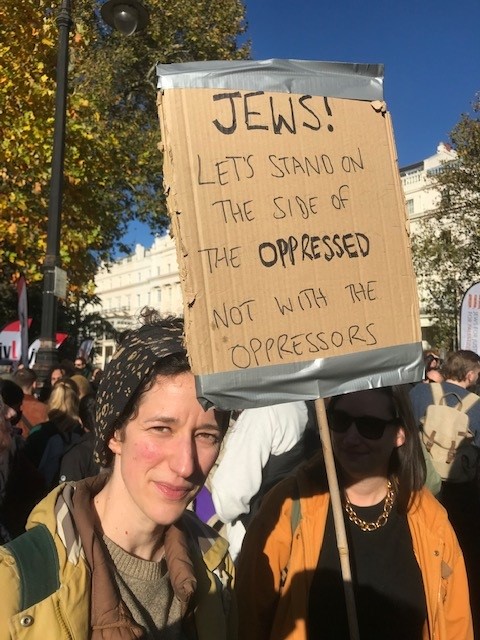
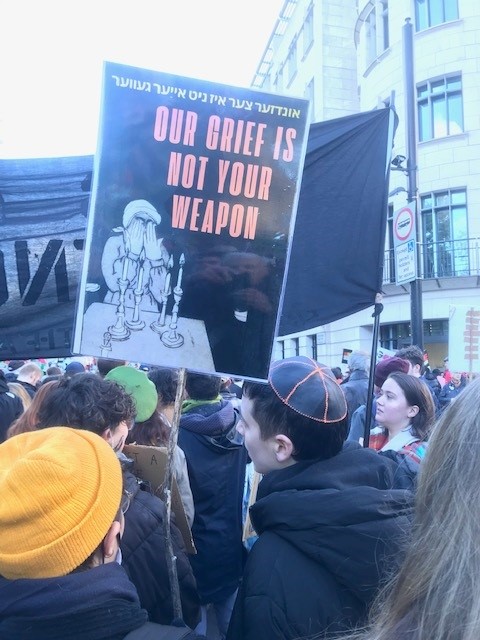
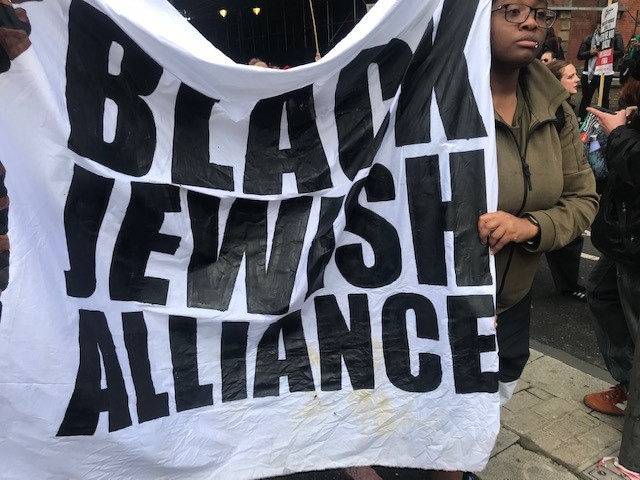
So, ‘largely peaceful pro-Palestinian marches’ somehow intimidate an assumed, homogenous Jewish community. Yet lots of Jews have been, and continue to be, on the demonstrations and marches, the Jewish organisations prominent with our banners proclaiming, well, being Jewish – and pro peace and justice for all in historical Palestine. Easy targets for intimidation. But intimidation came there none.
Far right violence
The violence that occurred on that 11 November march was undertaken by the far-right at, or near the Cenotaph. The Met said they made 126 arrests, the majority of whom were far-right protesters. Not surprising, for the pro-Palestinian march went, by agreement with the police, nowhere near the Cenotaph, and in fact our march did not start until around two hours after ceremonies at the Cenotaph were completed.
‘National emergency’? Or Hype?
My questioning the main stream narrative is not to be understood as denying that there have been antisemitic incidents and attacks, especially in areas where Jews, or Jewish organisations, businesses and schools are readily identifiable. However, what constitutes ‘intimidation’ is worthy of scrutiny.
Jonathan Freedland, the Guardian journalist, a man who should know better, in his article characterised matters as follows:
Now, it is certainly true that pro-Palestinian marches have included hateful messages – and that “from the river to the sea” is a slogan that literally allows no room for Israel, home to the world’s largest Jewish community, and so is heard by many Jews as a chilling call for elimination.
‘Literally’? No room for metaphor, no leeway for nuance of meaning? Calling for people to be free, free from oppression, is a ‘hateful message’. This is a gross distortion of the meaning of the ‘From the river to the sea…’ as already touched on above.
A wider concern
The fight against racism is, or should be, indivisible and conducted with equal vigour against all its manifestations. It is a concern, therefore, that anti-Muslim prejudice, worryingly prevalent, fails to attract either the media attention it deserves, nor does it benefit from the attention it deserves from politicians and the mainstream media , in marked contrast to the attention given to alleged antisemitism.
Tell MAMA (Measuring Anti-Muslim Attacks), reports a sevenfold increase in Islamophobic hate crimes since Hamas’ attack on October 7 compared to the same period last year. There has been a tenfold increase in cases at schools and universities. The 600% rise in incidents includes both verbal and physical abuse, as well as vandalism, with Acton Mosque in west London being splashed with red paint three times in two weeks. This is shocking, it hardly needs to be said.
There is, however, a particular aspect to this which particularly concerns me. That concern will be reflected through the short story I share at the end of this article. The concern is the degree to which our Muslim co-citizens are afeared of speaking in favour of Palestine – I know not its extent, but it chills – lest they be accused of antisemitism.
The 11 November march was glorious, hundreds-of-thousands of people marching demanding a ceasefire. I was carrying a banner, ‘Jewish Network for Palestine’, clearly indicating I was likely to be Jewish.
On this march, as in previous demonstrations, people spontaneously came over to thank me for ‘being there’. Telling me it was important I was there – this was the experience shared by others who held banners identifying themselves as Jewish – and how grateful they were. It was heartwarming, embarrassing – but worrying too. For the people who came over were Muslim, and they wanted to affirm they were not antisemitic, and our being at the demonstrations was a sort of testimony that there is no necessary conflict between us. Us, Jews and Muslims.
But how comes it that somehow the impression has been given that at least some Jews think Muslims are, by definition, antisemitic? How comes it that an atmosphere of chill and self-censorship has been perpetrated?
The short story
One of the people on the march came over to thank me but also to ask if his wife could take a picture of us together, me with my banner – Jewish Network for Palestine – his with his, the Palestinian flag. Two different flags, same message. Of course, no problem. Delighted. About a week later, his sending the photo to me prompted the following exchange:
You won’t mind if I ask a question: many people came over, as you did, to express appreciation at our being there. It also happened on previous demonstrations. The majority were Muslims, or those with a Muslim background. I read into this, apart from the heartwarming, generosity of spirit, that there is something to worry about, namely, that Muslims experience, or fear they will experience, accusations of antisemitism if they express support for peace and justice for Palestine, and this has a chilling effect on people. Does any of this ring true?
You are spot on with your analysis. As a Muslim, especially post-9/11, we have become conditioned to being fearful of speaking out at the risk of being branded pro-terrorism or antisemitic. We also fear this could lead to referrals to the police or PREVENT.
So, when we see non-Muslims speaking out against the same injustices, we feel a sense of elation (and admiration) that someone is expressing what we desperately want to. In the context of Israel / Palestine this appreciation is multiplied when the Jewish community stands by our side, as your voice carries greater weight and adds greater legitimacy to the protest. We also appreciate it may be difficult for you as you may experience a backlash from some within the community, that takes a level of integrity and bravery which isn’t lost on us. Hence, thank you 🙏
There is of course no need for thanks. But there is reason to worry.


 Bernard Spiegal
Leave a comment