Israel’s justification for its murderous onslaught on Gaza is that Hamas must be destroyed since it represents an existential threat to Israel; this, from its perspective, bloodily demonstrated in the events of the 7th October.
The current and continuing Israeli attacks on Gaza are justified in those terms: Israel’s objective is to seek out Hamas, its fighters, its military capability, its infrastructure; to destroy them utterly or, at least, to do sufficient damage to Hamas to neuter any future political and military threat. A military campaign to meet a military threat.
But when we look at Israel’s actions in Gaza, it’s difficult to reconcile what we see with the pursuit of legitimate war aims. The Israeli campaign seems to have objectives beyond those stated, beyond the destruction of Hamas.
Actions speak louder than words. With that in mind, we should focus less on what Israel says about its objectives, and more about what it is actually doing. What it is doing is wiping out, erasing, the possibility of a meaningful Palestinian presence in Gaza.
Genocide?
We need not entangle ourselves in the intricacies of what, in legal terms, constitutes genocide. It is sufficient to take a common-sense view of the meaning of the term: the deliberate destruction of a people, in whole or in part.
A death toll (as at 18 December since 7 October) of at least 19,453 Palestinians, about 70 per cent of which were said to be women and children. Some 52,286 Palestinians injured; and countless numbers dead or dying under the rubble of the buildings destroyed by Israeli lethal fire. Add to this the policy of starving Gaza of food, water, fuel, energy and the deliberate, focused destruction of buildings and infrastructure, then genocide seems a mild word in the circumstances.
But the term ‘genocide’ refers to the destruction, or complete marginalisation, of an entire people. So, to support the common-sense case that genocidal intent is at work here, we need to look at the West Bank.
The West Bank
Until quite recently, the focus has been predominately on Gaza. But the Palestinians of the West Bank have for long, and in particular since the election of the extreme right-wing, racist Netanyahu government, been subjected to increased oppression, state-backed murder, land theft; and the destruction of homes and livelihoods.
Since 7 October, 291 Palestinians, including 75 children, have been killed in the West Bank, including East Jerusalem. Of those killed in the West Bank, 281 have been killed by Israeli forces, eight by Israeli settlers and another two either by forces or settlers. With a total of 491 Palestinians killed in the West Bank, 2023 is the deadliest year for Palestinians in the West Bank since OCHA began recording casualties in 2005.
Settler Violence
Since 7 October, OCHA recorded 347 Israeli settler attacks against Palestinians, resulting in Palestinian casualties (35 incidents), damage to Palestinian-owned property (266 incidents), or both casualties and damage to property (46 incidents). In a significant number of cases, Israeli forces were either accompanying or reportedly seen as supporting the attackers. Since 7 October, 291 Palestinians, including 75 children, have been killed in the West Bank, including East Jerusalem.
Children: the target, or collateral damage?
Genocidal intent is perhaps most eloquent in the attention it pays to children. That is, the horrifying kill- and injury-rate of Palestinian children perpetrated by the IDF and settlers. These killings, like all Israeli killings of Palestinians, rarely if ever result in a criminal charge, still less a conviction. But non-action is but the logical outcome of a particular worldview. For why would you consider that anything needs to be done in respect of the murdered children if it’s believed they should not be there in the first place. Because they represent both the here and now, and the promise of a future, children are the ultimate rebuke to those with genocidal intent.
Paradox
Perhaps paradoxically, or at least oddly, what marks out most starkly Israel’s genocidal intent is, yes, the tearing apart of human flesh and viscera, but also, most evocatively, the frenzied obliteration of the art, artefacts, cultural markers of a civilisation; of a Palestinian civilisation rich in meaning and value. A sign, perhaps, that Israel is not fully persuaded of its own beliefs; of its mythisotry.
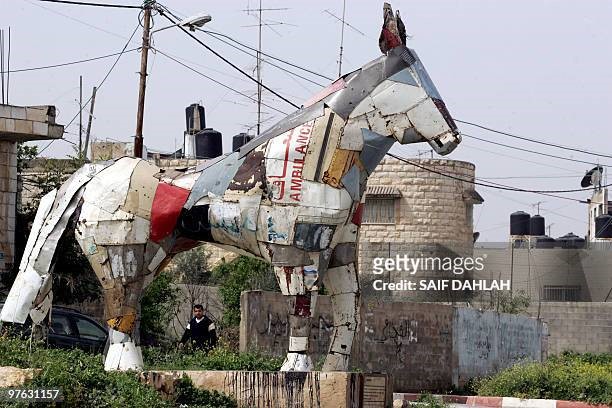
Thus does the militarised Israeli horde appear to delight in smashing all monuments in the Jenin Refugee Camp including the “key of return” at its entrance. The army also destroyed and plundered the great, tin horse at the hospital entrance, constructed by a German sculptor from the wreckage of destroyed Palestinian ambulances, a monument to the dead. In Tul Karm it demolished the Yasser Arafat memorial. Israel is erasing Gaza’s beach promenades, villages and its cultural institutions, universities and archaeological sites.
Amira Hass puts it thus:
According to the ideology and policies of Jewish settler colonialism, the Palestinians are superfluous. In short, it is possible, worthwhile and desirable to live without the Palestinians in this country between the river and the sea. Their existence here is conditional, dependent on our wishes and our goodwill – a matter of time.
[In July 2021 Hass wrote] ‘The ideology of ‘superfluousness’ is a poison that spreads especially when the process of settler colonialism is at its height. … Settler colonialism is a continuous process of grabbing land, distorting historical borders, reshaping them and then expelling indigenous peoples.’
I referred to the ‘superfluousness’ of the Palestinians in the West Bank and warned about the intentions to expel them. I assumed then that the viewing of Gazans as superfluous sufficed with severing them from their people and their families on the other side of the Erez checkpoint that separates Gaza from the rest of the land (Israel and the West Bank).
But now the ‘superfluousness’ is being reflected in expulsion, disguised as voluntary under the shelling. It’s being reflected in the physical erasure of the Gazans, and in plans to return Jewish settlers to Gaza. Woe to them and woe to us.
Augur’s ill
Israel’s actions in Gaza, the West Bank and East Jerusalem, can be read as auguring radical moves, both in Gaza and the West Bank: population expulsion from Gaza; severe – even more than currently the case – population containment in the West Bank.
If history is anything to go by, the immediate future does not augur well.


 Bernard Spiegal
Leave a comment