What has become obscured, perhaps avoided, is that the very idea of splitting historic Palestine into two states, was always unjust, and because of that, unsustainable in the longer term.
The deeper meaning of the two-state proposal lies in its key function, which is to legitimise the creation of a state overtly based on ethnonationalist, colonising principles. In that sense, Israel represents, and continues to represent, an historical throwback, standing as it does against the anti-racist, decolonising wind that, post-1945, was blowing colonial regimes into a thing of the past.
The two-state ‘solution’ was, from its inception in the original partition plan, a way of fobbing off Palestinians, this adequately demonstrated by Israel being awarded 55% of Mandate Palestine, though the Jewish population at the time comprised only a third of the county and the land they owned, only 6%. The current ‘solution’ continues in the same vein, though in aggravated terms. It envisages a Palestinian state, further truncated, shrunk to a paltry 22% of Mandate Palestine, and forced to live cheek by jowl to a predictably overweening Apartheid state. Can this be seriously considered a real-world ‘solution’?
The nature of Zionism
Zionism is a colonising project. The aim: to create a Jewish State in Palestine – in the entirety of historic Palestine. By definition, achievement of that goal required and still requires the removal, or significant reduction, of the indigenous Palestinian population.
The evidence is before our eyes: in Israel’s history, in its current policies, and now under Netanyahu’s new, even more extreme, racist government. On a daily basis, the colonising intent is graphically demonstrated by Israel’s actions in the West Bank, annexed East Jerusalem and Gaza. On what grounds, therefore, has it ever been thought that (a) there was any justice in limiting a Palestinian state to either 45%, and now 22% of historic Palestine; and (b), that Palestinians would over the long term accept that as their meagre entitlement?
Not a durable ‘solution’
It seems increasingly inconceivable that younger generations of Palestinians will be prepared to accept a shrunken state that, from its inception, cannot but fail to meet their legitimate aspirations for meaningful nationhood.
The strength and steadfastness (sumud) of so many Palestinians, their visceral attachment to the land and homes that were once theirs, seem as strong as ever. The symbol of a key, representing the locks of the homes that Israel forced Palestinians to leave in 1948 – the Naqba – is as potent as ever, testament to a rooted connection to land and place.
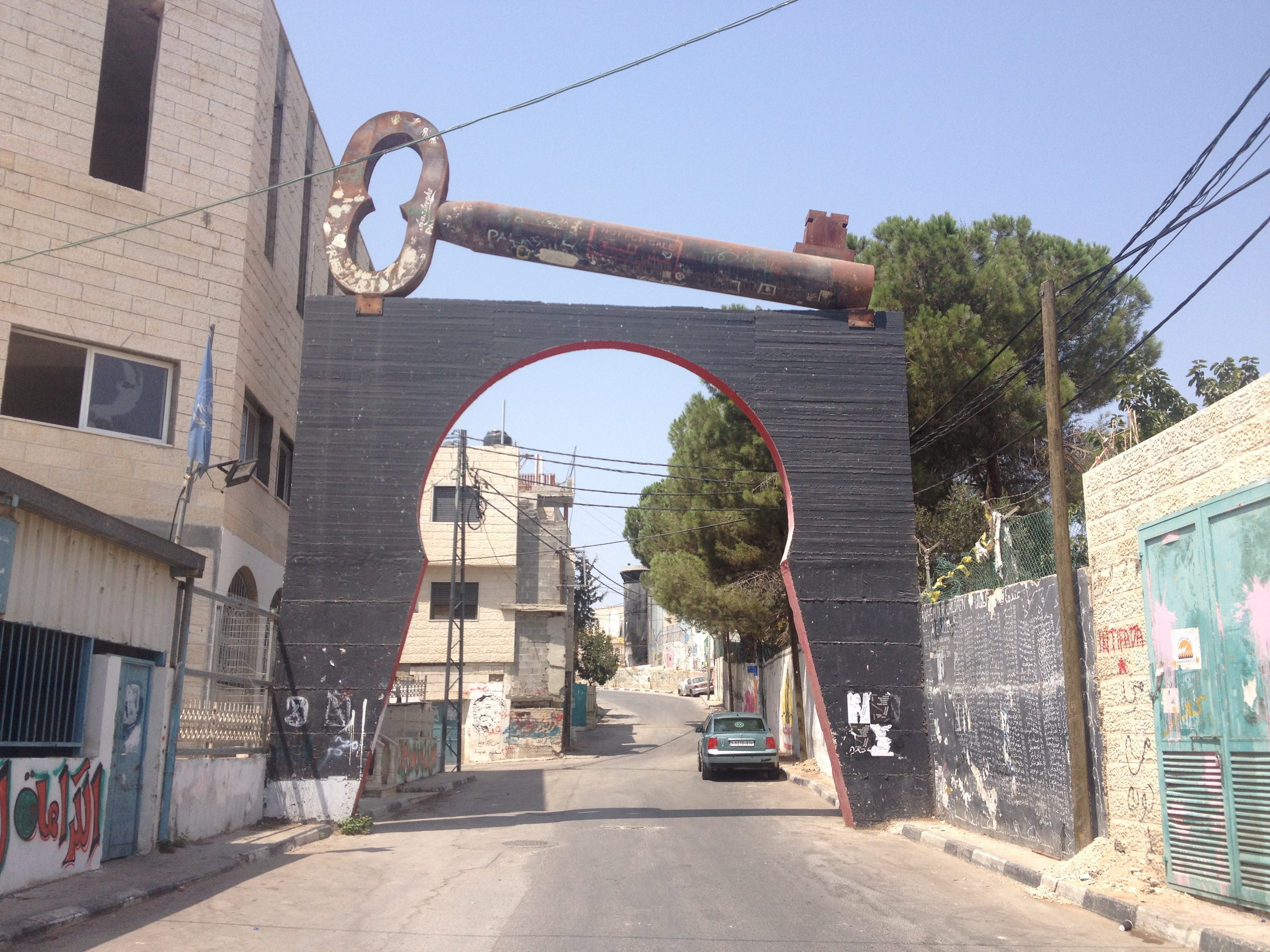
Entrance to Aida refugee camp
At present, significant parties, state and non-state, have too much invested in the two-state proposal to acknowledge its demise. But there are straws in the wind that it is to be hoped portend the possibility of change. That change has to be in the direction of one state. As the Israeli historian, Avi Shlaim puts it:
‘The best hope for resolving the century-old conflict between Jews and Palestinians lies not in the partition of Palestine but in building one democratic state from the river to the sea with equal rights for all its citizens, regardless of religion or ethnicity.’

 Bernard Spiegal
Leave a comment